What is Hoarding Advertising?
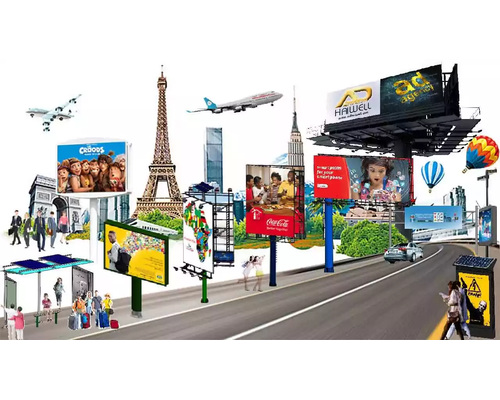
Hoarding advertising uses large billboards strategically located in heavily populated areas to advertise a product, service, or brand. This type of outdoor advertisement is known for its size and ease of seeing, making it a very strong marketing instrument for companies that want to fortify their brand presence.
Subpoints:
- Important Information: Hoardings can be constructed from various materials, such as vinyl, metal, or fabric, and they can be illuminated or non-illuminated based on the objectives of the advertising campaign. An example of a successful hoarding campaign is the Coca-Cola “Open Happiness” campaign, which was exhibited on large billboards during major public events.
- Statistics: On the other hand, the Outdoor Advertising Association of America, which covers hoardings, has a 6.5% annual increase in this kind of advertising, meaning that it is more efficient in reaching a bigger audience.
- Frameworks: The AIDA (Attention, Interest, Desire, Action) model relating to hoarding advertising can be further understood by the brand for the customers, where the prominent commodity being shown attains the desired attention, triggers the necessary interest in the brand, creates a product-energy, and motivates the individual toward the purchase through better brand identification.
Varied Types of Hoarding Advertisements
There are different hoardinsements, each fitting the marketing needs and targeting various audiences.
Subpoints:
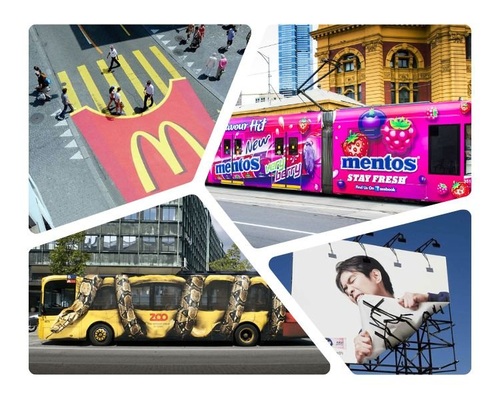
- Types: Distinct types of billboards, such as static hoardings, which are just plain fixed boards, represent one of the primary types. In contrast, the other prominent example is digital billboards, which can easily show dynamic content. 3D hoardings are another creative format involving people virtually and can be thrilling. For example, a well-known company in the beauty and makeup industry successfully developed a 3D hoarding system designed to deploy a plain image as a visual correlation of a time-lapse. Thus, it got much attention.
- Challenges & Benefits: Even though the placement is great and offers good visibility, companies still need help with such challenges as high costs or regulatory permission. Nevertheless, they create many benefits, including only one consistent brand recall over a long time and possibly reaching many people in a place with high traffic.
- Practical Strategies: Hoarding campaigns that function well involve details, such as advertising to a precise location after using the demographics and data obtained, along with strong visuals and to-the-point messages, and inserting QR codes for further interactive purposes.
The Future of Hoarding Advertising: Trends and Implications
With the advertising landscape progressing, hoarding advertising has to keep pace, and hence, it has to adopt new technologies and embrace new trends that contribute to its growth.
Subpoints:
- Insights: The predominant innovation seen lately is augmented reality (AR) technology, which is increasingly used in these ads and lets customers view and engage with the advertisement through their smartphones.
- Emerging Issues: In an era when only a full-sized TV would count as big, brands gave digital media ads general superiority, ignoring the inclination towards eyesight. Nobody can deny that traditional and digital marketing is the key to success because people become more tech-savvy daily.
- Industry Implications: Marketers who invest in hoarding advertising have a chance to make themselves noticeable in an otherwise full marketplace. Data analytics can improve targeting and make campaigns reach just the right prospective customers at the right time.
Conclusion
In the end, hoarding advertising is still known as one of the most powerful and persuasive forms of advertising, mostly positioned on streets and highways, and it guarantees the delivery of brands with high obtainment and direct communication. Companies can design engaging plans that will appeal to their target audience by using several types of hoardings, such as traditional and digital billboards, digital screens, and customizations of buildings. The huge reach that hoarding advertising provides due to its prolonged visibility and creativity contributes to its standing as an important part of the marketing strategy.
Key Highlights:
- Hoarding Advertising Defined: A kind of outdoor advertising in which big structures show promotional content.
- Types of Hoarding Advertising vary from traditional billboards to modern digital displays and artistic installations.
Benefits
- High Visibility: Situated in a crowded place so the advertisement can reach the maximum audience.
- Unconventional Creativity: Gives opportunities for creating trendsetting and iconic campaigns.
- Longevity: Advertising can be done for extensive periods and can, at the same time, maintain the brand identity and place.
- Real-Life Examples: Effective brands’ campaigns that used hoardings and entertained spectators.
An in-depth understanding of the role of hoardings in advertising campaigns enables organizations to efficiently capitalize on their strengths to create brand advocacy and generate customer loyalty.
]]>- Environment and Surroundings: Indoor advertising takes place in ant, whereas environment outdoor advertising takes place in open spaces in public areas.
- Targeting Audience: There is an indication of a demographic affinity, whereas the reach is wider in the case of outdoor advertisements.
- Cost: Indoor advertisements are less expensive, but it is costlier to give increased coverage with outdoor advertisements.
- Time Spent in Attention: Indoor advertisements capture attention for extended periods, while outdoor advertising has to hold the viewer’s attention even within a fraction of a second.
- Content Intensity: Indoor advertisements are likely to be more verbose than outdoor ones, which usually tend to be short but highly creative.
Your choice between indoor and outdoor advertising depends on the nature of your product, your target audience, and even the desired impression. For instance, indoor ads enjoy a captive audience and a more focused environment. Outdoor ads take advantage of communicating to a broad audience using all their preferred exposure. This blog deeply deeply deeply explores some key differences between indoor and outdoor advertising—including unique characteristics, benefits, and ideal use cases.
For marketers, choosing the suitable medium is more than just visibility—crafting a message that resonates in the right setting. As such, each form of advertising has its strengths and limitations, and drawing the most appropriate one depends on a very detailed understanding of how each environment affects consumer behaviour. Let’s take a step forward and examine the critical differences between indoor and outdoor advertising.
Critical Differences Between Indoor and Outdoor Advertising
1. Surround and Environment
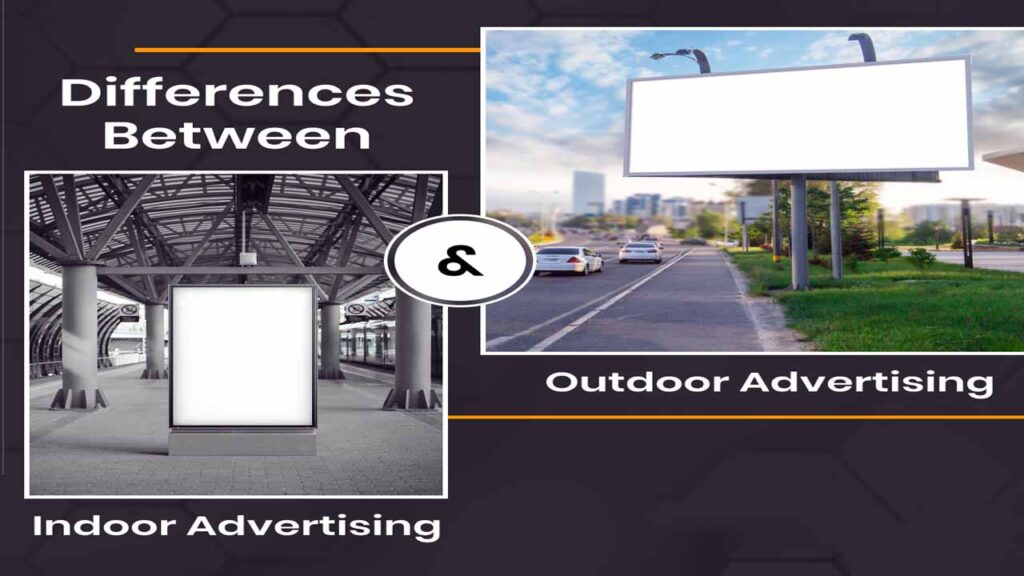
The environment that an advertisement receives would make the audience perceive it in a particular manner. Indoor advertising is performed within controlled surroundings—shopping malls, restaurants, gyms, and corporate buildings. Such an environment allows for more elaborate and intricate advertisements because the recipients are static and have much time to focus on the message. This ranges from typical indoor displays with digital screens, posters, and standees that offer a variety that easily integrates with the theme and ambience of the surroundings.
- Controlled Environment:
It is placed in regions where focus can be charged and executed with details. - Sophisticated Messaging:
The advertisements can bear longer messages and complicated designs to allure the viewers. - Audience Engagement:
Because they are stuck in place, the viewers have ample time to engage with the advertisement. - Integration with Environment:
Indoor large-format advertisements are designed to integrate correctly with the surrounding environment where they will be situated, providing a cohesive experience for the viewer. - Tapping Technology:
Digital display mediums, due to their dynamic content, contribute more to engagement opportunities.
On the other hand, outdoor advertising is distributed across open public places like highways, roads, transport stations, and city squares. In such cases, the primary goal of outdoor advertising is to be seen quickly since there is not enough time to read and comprehend the advertisement. Standard outdoor advertising comes in hoardings, posters, and transit ads, as their specialty encompasses broad visual activity supported by short messages. The environment is less controlled, and the ad must stand out against interfering elements like traffic, buildings, and other outdoor advertisements.
- High Visibility:
There is generally a much higher view of outdoor advertising, often a glance. - Short Message:
Since time is usually the constraint, messages must be short and catchy. - Active Content:
Outdoor billboard messages normally are action-grabbing, first-impression stimuli. - Competition:
In many ways, outdoor advertisements compete with the environment. So, images have to be striking. - Diverse Locations:
Such billboard messages can appear at various places, giving the advertisement more exposure to mixed crowds.
The environment also decides the content that will go well with it. Indoor advertisements can be detailed and subtle in their message, while outdoor advertisements must be relatively short and catchy. It is vital to understand the characteristics of the environment in which the advertisements are spread out, as this aspect will determine a flawless ad for an audience within each environment.
2. Targeting and Engagement with the Audience

One of the significant differences between indoor and outdoor advertising is the ability to target and engage specific audiences. Indoor advertising is targeted and allows strategic placement in locations where the target audience spends more time. For instance, pasting an advertisement on the walls of a gym for fitness enthusiasts or utilising digital signs in a technology store for branding the newest gadgets are examples where indoor advertisements may be crafted and tailored toward a targeted audience. This narrowed detail targeting could translate to more significant campaign involvement; the ads speak more directly to what the listener has within immediate space and interest.
- Location-specific Adverts:
It can be displayed indoors where the target demographics are more likely to view it. - Contextual Relevance:
Content can become relevant to the needs and interests of an audience in that particular setting. - Tailoring Opportunities:
The demographic present determines the type of tailoring indoor adverts may experience. - Interaction Opportunity:
The more extended exposure opportunity offers more elaborate messaging and possible interactions.
On the contrary, outdoor advertising aims to attract the attention of as many individuals as possible. It is primarily for mass awareness rather than individual targeting. This is because the demography spreads through outdoor ads, making it well-suited for products and services targeting a mass level. For instance, a national fast-food company can use billboard advertising to introduce a new menu item. People in private and public transport and pedestrians will be exposed to the billboard. Since one may have a concise exposure window to outdoor advertisements, creating a memorable visual with taglines is necessary.
- Highly Visible:
The target audience will be a diverse range of potential customers. - High Mass Appeal:
Fits products or services of broad market relevance. - Fast Impact:
Messages have to reach audiences quickly since they are often in motion. - Memorable Design:
The focus of outdoor advertising is on visual elements that are as influential as possible and, therefore, attention-grabbing. - Low Interaction:
By the nature of the exposure, low interaction can only be achieved with quick impressions, making visuals very critical.
The engagement levels also differ from one medium to another. An indoor ad benefits from a more engaged audience who may spend several minutes or more near the ad, while outdoor ads must make an impact within seconds. That is where the difference lies, and accordingly, the design and message in each ad type differ from one another: depth and detail for the indoor ads and simplicity and colour appeal for the outdoor ads.
3. Cost and ROI
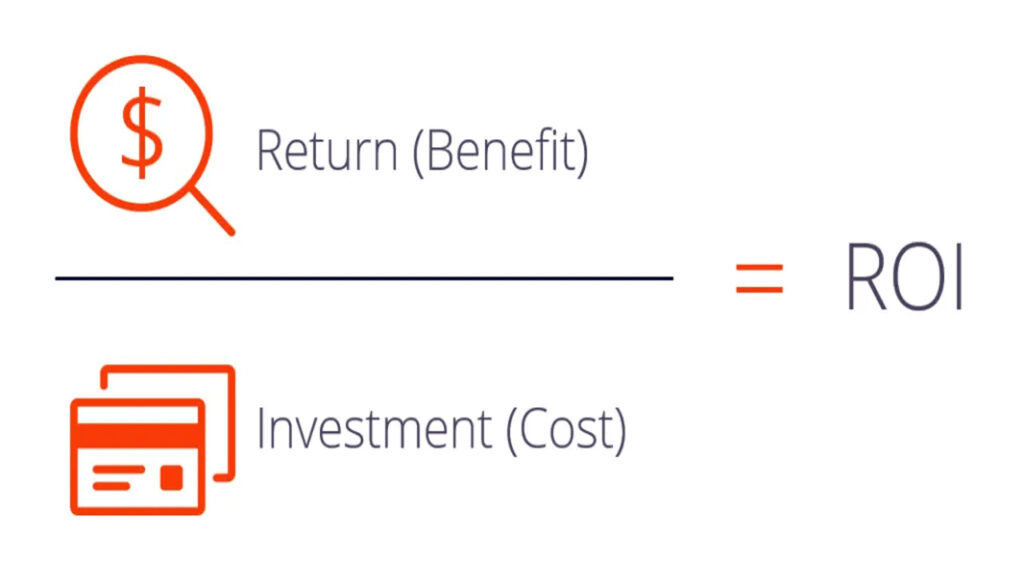
Indoor and outdoor advertising have an excellent cost disparity, whereby return on investment tends to be affected. Indoor advertising is relatively cheaper as it uses smaller advertisements within actual locations. The price will depend on factors such as the display size, the campaign duration, and niche targeting; indoor advertising would be a good fit for small businesses or local brands because it is cheaper and has a more effective return on investment.
- Low Overhead:
Indoor advertising productions tend to have a lower overhead. - Small Placements:
Targeted spending on focused demographics can be conducted through small placements. - Higher ROI:
Showing tailored messaging will yield higher conversion rates. - Budget Flexibility:
Brands can budget for targeted indoor spaces for specific periods. - Potential for Local Marketing:
For most local businesses, a successful strategy in indoor advertising would prove cost-effective.
Online advertising is simply the replacement. A billboard costs significantly more, especially when there is a lot of traffic and at strategic locations. However, the higher cost is justifiable through large-scale cover and brand reinforcement. In the case of giant corporations or national campaigns, outdoor advertising can generate high mileage through appreciation of solid brand awareness and top-of-the-mind recall.
- Higher Upfront Costs:
The initial investment for outdoor advertising is much higher. - Greater Reach Justification:
The cost is justifiable with broad exposure to the audience. - Brand Awareness:
Once the advertisement is blatant, it will likely increase the recall and recognition of the brand. - Large-Campaign Placement:
Outdoors work well when brand awareness strategies are used over a long period. - Market Saturation Opportunities:
Outdoor ads saturate specific regions for increased visibility and presence.
Deciding whether to use indoor or outdoor advertisement is critical as it means businesses should weigh their budgets, campaign goals, and the impact they anticipate getting for each. Indoor ads are usually more engaging; however, outdoor ads are where more awareness and visibility are made in deciding; therefore, much lies in choosing a style of advertisement that will give you the most return on investment and reach the goals set out during marketing.
Final Thoughts
Understanding the differences between indoor and outdoor advertising will guide any business in adequately using the media. The importance of intensive messaging through indoor ads works very well in places where people have enough time with the content. Outdoor ads—prominent, reaching a broad target audience—are used to spread large-scale awareness about the brand.
- Application of Purpose:
The choice between indoor and outdoor advertisements must match a particular marketing objective. - Behaviour of the Audience:
Understanding the impact of the environment on consumer behaviour is the only way forward. - Hybrid Approaches:
An amalgamation of indoor and outdoor ads is an all-inclusive approach to market coverage. - Choosing Ad Types:
The company has to evaluate the budget and expected return on investment. - Effectiveness Measurement:
The performance of the advertisement is measured constantly. This is a crucial step for devising advertising strategies.
Both indoor and outdoor advertising offer different advantages, and a business must choose according to its goals, budget, and ideal target group. A mix of the two can provide an all-around approach, reaching consumers at different stages of their day-to-day living. Whether in the form of a strategically positioned poster at a retail store or a gigantic billboard placed along a bushighwaywa ehighwahighway, retirement has a specific function within the rationale of a more extensive campaign.
]]>In today’s competitive marketplace, the characteristics of advertisements are useful and essential for businesses that hope to make an impression and engage their customers. Advertising is much more than just another sale. It is a clever mix of creativity, psychological insight into the consumers’ minds, and emotional appeal to them. As companies scurry for consumer attention, these characteristics should form part of a critical foundation for developing powerfully effective advertising strategies.
Here’s why knowing the characteristics of advertising is pretty important today:

- Engagement of Consumers:
The suitable ads stimulate interest, compelling people to talk and share with social media. - Defining Brand Identity:
Strong advertisement helps build a brand’s identity and distinguishes it from competitors.
A well-crafted advertisement can communicate an idea explaining a brand’s values, mission, and USPs. - More Sales Conversion:
In most cases, well-designed ads result in higher conversion rates and revenue.
Advertisements build urgency that makes the consumer behave or act for buying or subscription to a service. - Social Presence and Reputation Management:
Advertising has become an important tool for managing and establishing a business’s social presence in today’s digital world.
Strategic advertising is used to develop a good brand reputation, which may create loyalty and advocacy for the brand in the market. - Adaptation with Trends and Consumer Behaviour:
Knowledge of advertising features empowers companies to be sensitive to changing trends, consumer behaviour, and technological times.
Data analytics and market research enable brands to develop campaigns that speak directly to the target audience. - Communication of Value Propositions:
Advertising acts as a medium where value propositions for products or services are made visible.
A well-executed advertisement strategy may help consumers feel their questions are answered and alleviate concerns so that they can better understand the purchase. - Influencing Purchase Decisions:
Advertising is crucial in changing attitudes and perceptions, leading them towards purchase.
A well-written message can make people feel, believe, and act accordingly. Hence, advertising has become an essential tool in marketing.
Characteristics of Effective Advertising

As we go on reading this blog on advertising, it will address most of the following key points:
- Characteristics of effective advertising
- Storytelling in grabbing the audience’s notice
- Emotional appeals as decision-makers for consumer behaviour
- Clarity and Brevity in Communication
Did you know that 73% of consumers have had an adverse reaction to an ad due to lack of relevance? Let’s discuss the essential characteristics that make advertising effective and critical to any successful marketing campaign.
1. Purposeful Message
Advertising is deliberately designed by themselves. Each advertisement is intended for a particular purpose, aimed at achieving specific goals:
- Sales generation:
Most advertisements are designed to induce prompt purchases.
Certain CTAs encourage potential buyers to “buy now” or “act fast.” - Awareness creation for a product, service, or brand:
Advertisements bring awareness of the product, service, or brand available to prospects.
The advertisements help prospects learn what they possess as alternatives. - Knowledge Power:
Some ads educate the consumers about the new products, features, or benefits.
Ensures the target audience understands what is on offer and how it resolves their needs.
2. Target Audience Focus

Good advertising acknowledges that all consumers are not the same—customer messages need to be targeted towards specific groups:
- Demographic Targeting:
Sometimes, advertisements are crafted for particular demographics based on age, gender, income brackets, and geographical area.
The more focused the message becomes, the more the relevant group hears it. - Psychographic Profiling:
Good advertising considers the kind of interests, attitudes, and lifestyles the target audience may have.
Messages are developed based on their interests and habits. - Behavioural Segmentation:
Analysis of behaviour and purchase history further specifies the message.
Targeted and relevant ads enhance the chances of getting high-engaged views.
3. Creativity and Innovation

In a competitive marketplace, advertising alone and creativity are everything. Creative ideas catch consumers’ eye and also create an impression that the advertisement is remembered:
- Visual Attraction:
Attractive images and exciting visuals are vital things for viewer attraction.
Different colours, typography, and images capture the feelings of the viewer. - Storytelling:
Creative storytelling creates engagement and loyalty.
Successful advertising integrates stories the consumer will recall. - Humor and Emotion:
Using humour or “emotional” content makes an ad more memorable.
Tugging at emotions allows a brand to connect on a human level, building better memory and recall.
4. Channels and Mediums Diversification

Advertising approaches and mediums are diverse to reach out to its audience, so is each of them used for:
- Digital Advertising:
Nowadays, the foundation from the bottom of the funnel, social media, search engines, and websites are at the centre of all advertising strategies.
Internet ads are interactive and measured in real-time. - Print Advertising:
Newspapers, magazines, booklets, and fliers can still work well with regional markets.
Print advertising may provide tangible imagery that some customers will enjoy. - Broadcast Advertising:
TV and radio advertising can still be a mass-reach vehicle.
Both deliver the ability to communicate to a mass audience and often carry an air of credibility.
5. Measurement and Analytics

A data-driven society calls for measuring an advertisement campaign’s effectiveness in the present day. Businesses have been making investments in analytics to understand the return they get on such investments:
- Performance Metrics:
Return on investment (ROI), click-through rates (CTR), and conversion rates are metrics that help marketers understand a campaign’s efficiency. - Consumer Insights:
Data Collection tools provide insights into the preferences and behaviour of consumers.
Brands can now focus on perfecting the advertising strategy to get better results. - A/B Testing:
This method relies on comparing two versions of an ad to determine which performs better.
Data-driven decision-making leads to more optimised advertising strategies.
6. Consistency and Brand Voice

A good campaign should cultivate consistency and maintain the voice of the brand across all media:
- Brand Identity:
Each advertisement should relate to the core message of a specific brand’s values and personality.
A constant visual and verbal image makes consumers believe and trust. - Message Repetition:
Consistent exposure to a consistent message brands identify with.
Greater consumer awareness and remembrance occur through consistent communication. - Cross-Promotional Activities:
Incorporating advertisements into various media ensures the delivery of the same message about the brand.
Has a more significant impact and meaning.
7. Adherence to Regulatory Frameworks
Advertisements are subjected to several legislations and regulations through which the ethical messages are maintained:
- Advertisement Truthfulness:
Advertisements should not mislead or lie.
There should not be false statements or advertisements regarding the brands’ products or services. - Cultural Sensitivity:
Understanding and being sensitive to cultures does not make one suffer a backlash.
Messages in advertisements should not be hurting communities or demeaning them. - Data Privacy:
Using people’s data for digital advertising demands much stricter regulations, such as GDPR.
Keeping consumers’ information confidential is the most authentic way to build trust.
8. Flexibility

Gone are the days when advertising was merely a matter of stick and dough. The growth of advertising has to keep changing the guard to keep pace with the ever-changing world of trends and consumer behaviour:
- Trend Analysis:
Advertisements should be able to incorporate and adapt to the latest trends.
This keeps them relevant in the minds of the consumers. - Integration of Technology:
It can adopt technologies such as artificial intelligence (AI) and machine learning to enhance ad targeting and the overall effectiveness of the campaign. - Feedback Loops:
The mechanisms through which it can collect consumer feedback on the brand side would determine the changes in strategy.
Fast adjustments driven by an audience’s responses lead to effective outcomes.
Final Thoughts
In conclusion, understanding the nature of advertising is crucial for anyone navigating the marketing jungle. Below are the seven essential traits that make any advertisement effective: clarity, persuasion, relevance, creativity, emotion, consistency, and targeting. While these characteristics ensure an ad reaches people and affects them, each has an important role to play.
- Clarity:
Clarity is the first key to reaching an audience without affecting them. An advertisement might be handed over to the audience, but it wouldn’t affect people if its message is hazy and unclear.
Gives a clear understanding of the product or service being offered.
A straightforward message attracts attention and leads to higher engagement. - The Emotion Factor:
Relates the consumer to the brands.
Emotive adverts are more effective for memorable experiences that have higher loyalty levels. - Right Audience:
Success in advertising revolves around reaching the right target audience.
Message tailoring will likely lead to more excellent application, effectiveness, and return on investment.
As we take our steps forward in the world of fast movement and technology, we will consider all these elements of profile that help improve advertising strategies and enable businesses to create campaigns that are really meaningful to their target audience. Advertisements lean on these core features to promote enduring connections with consumers and boost sustainable growth for brands.
]]>Ready to talk with a marketing expert?

A Pragmatic and innovative way to enthrall your target group is just a click away!
Get in Touch
Rukmini Knowledge Park, Kattigenahalli, SH 104, Srinivasa Nagar, Bengaluru, Karnataka 560064
+91-990 247 8800
contact@gingermediagroup.com
Popular in Television Advertising
Udaya TV AdvertisingSun TV AdvertisingStar Plus AdvertisingTV 9 AdvertisingZee TV AdvertisingNDTV India AdvertisingColors TV AdvertisingPopular in Airport Advertising
Spice Jet AdvertisingMumbai Airport AdvertisingDelhi Airport AdvertisingEmirites AdvertisingIndiGo Airlines Domestic India AdvertisingPopular in Newspaper Advertising
Deccan Herald AdvertisingPrajavani AdvertisingThe Hindu AdvertisingEconomic Times AdvertisingDainik Jagran AdvertisingHindustan Times AdvertisingPopular in Magazine Advertising
Forbes AdvertisingCosmopolitan AdvertisingBusiness World AdvertisingVogue Magazine AdvertisingPopular in Sports Advertising
IPL AdvertisingPopular in Outdoor Advertising
Billboard AdvertisingBus Shelter AdvertisingMetro Pillar AdvertisingUnipole Advertising© Ginger Media Group 2025. All Rights Reserved.