Aren’t you surprised? We do not blame you. You’d expect this tech-savvy generation to ignore ancient advertising mediums because the digital world takes up most of their time. However, as a recent Kantar Study points out, their ad preferences don’t replicate their habits.
“Gen Z Use online like OOH (Out-of-Home).” This statement headlines Kantar Millward Brown’s advertising habits study. This is often a generation of individuals who’ve had Facebook and Instagram profiles all their life. They consider their smartphones a lifeline associated with degrees and an extension of themselves.
Today over eighty million young Millennials represent $200 billion in annual shopping for power.
Millennials and Gen Z comprise nearly 1/2 of the United States of America population and represent the foremost cogent shoppers. However, Millennials and Gen Z are the elusive central audiences to interact with, as they lead the charge on cord-cutting, ad-blocking, and radio-streaming.
The shift in audience consumption habits has resulted in a lot of investment in out-of-home (OOH) promotion. Irrelevant ads have a steadfast, evergreen quality that appeals to most younger shoppers and, in distinction to different media channels, can not be unnoted by skipping, fast-forwarding, or paying a lot to avoid ads.
Here are three reasons why out-of-home advertising is the best media for reaching Millennials & information Z:
Authentic and real-world expertise resonate.
One of the only things the overwhelming majority of Millennials agree on is that they don’t wish to be marketed to. Gen Y craves genuineness, with eighty-nine preferring easy ads and ninetieth noting they need a brand’s messages to match its actions.
Gen Z conjointly values genuineness and real-world experiences. In fact, in line with a recent international study by Kantar Millward Brown, OOH is the #1 most popular ad format among Millennials and Gen Z.
And in line with Nielsen, “One out of each four shoppers can post a picture of a door ad to Instagram.” Shoppers are 48% likely to click on a mobile ad once being exposed to a similar ad on associate degree out-of-home advertising initially.
While Gen Y and Z shoppers love content, they need very little tolerance for interruptive ads – creating irrelevant ads and experiential media is a vital medium for marketers as they appear to make awareness, relevance, and affinity with younger shoppers.
Shorter attention spans during a digitally saturated world

Gen Y and Z have voracious appetites for content but conjointly shorter attention spans. Gen Zers grew up with smartphones. Their 8-second span is even faster than Millennials, who pay grievous bodily harm of twelve seconds on average.
Gen Y and Z are aligned in their media consumption habits. They like watching videos on-demand. Over twenty-fifths of Gen Z watch live TV on mobile, with a better proportion streaming on-demand video.
Digital and social media ads have become more saturated and less effective than ever. Facebook and social platforms currently throttle branded content in the news feed, making it more durable for brands to achieve their target shoppers.
To overcome this challenge, brands are increasing their promoting pay and outside ads, bolstering direct-to-consumer engagement within the native market with authentic content relevant to their daily lives.
Improve Brand Engagement

With advertisements that address the problems of society at large, OOH advertising helps the brand engage audiences and leave a mark on their minds. According to various research, about 48% of millennials are more likely to click on the mobile advertisement of a brand after being exposed to an OOH advertisement of it first. People are more likely to know more about your brand if you are running an OOH advertising campaign, instead of an online marketing campaign.
Also, if your billboard addresses a social issue, it is more likely to be shared online by your target audience and reach millions of people. This will also bring down your expenditure while maximizing impact and revenue.
Improves Market Presence

With an increasing number of people going for in-store experiences, OOH advertising is at an all-time high. Over 92% of the people admitted to noticing an OOH advertisement while out shopping for groceries or other stuff. It also helps build customer loyalty. More people tend to buy from a brand they know about, instead of the brand about which they have only seen a few ads online. Thus, with OOH advertising your brand’s market presence is boosted and more people tend to know about your brand. This will certainly boost people’s trust and loyalty to the service.
Improves Social Media Presence

About 46% of people tend to share pictures of OOH advertising on their social media accounts if they find it as something relevant or something that they relate with. This helps boost the social media presence of your service hence improving the conversion rates and the number of likes on your page. This helps your service land on top of search engine pages and improve your conversion rates. This also helps bring down costs for advertisement as the major outreach is done via social media and your brand makes a mark socially while resonating with the masses.
Conclusion
OOH advertising is the number one form of advertising your brand nowadays. It is the form of advertising that not only helps you gain more customers but also helps your brand create a market presence, resonate with the masses and provide a social outlook to your brand as well. Hence, this form of advertising helps your brand shine through and gain attention from the ever-busy millennials and Gen Z.
Advertising at the right places, keeping in mind the short attention span of the audience definitely will help the brand carve a niche for itself. Having said that, it is extremely important that your brand does create its space in the market to outshine the other products and generate revenue.
Monitoring the public response will also help you plan the future course of advertisement for your brand and to ensure that your brand does create a market of its own.
We at Ginger Media understand that not everyone is well versed when it comes to OOH advertising. So, we are here to help you out! We would love to assist and make the task radically simpler for you!
Please feel free to drop us a comment to suggest what would you like to see more of. 
If you are a medium or a large-sized business in India, looking to do sustainable, profitable, effective offline marketing, OOH advertising, BTL activation, auto branding, bus branding, RWA or anything that has to do with traditional media and offline marketing, branding, give us a call at +91-8884442846 or drop us an email at contact@gingermediagroup.com.
]]>What is outdoor and transit media branding?

Outdoor media is a form of media advertising which takes place outside the homes of people. That is, it is displayed in the form of billboards at flyovers, kiosks, digital billboards, hoardings, and signals near the road at the pedestrian path, the outdoors to be viewed by a mass population.
On the other hand, transit media branding also advertises outside, but it places advertisements on vehicles or transits which is why it is called transit media advertising. It is one of the prevalent ways of advertising for brands today.
Outdoor advertising differs from transit media advertising
1. Billboard Advertising
It is found that around 83% of people do remember the OOH advertisements they view 30 mins before shopping. Billboard advertising is on a rise. We view it as constantly evolving and changing advertising. In a highly digital world, hoarding advertising is done to provide a more realistic, immersive, and engaging brand experience to consumers. Billboard advertisements are stationary whereas transit advertisements like bus ads, auto rickshaw ads, or metro ads are non-stationary.
2. Street furniture
Street furniture is another popular form of OOH advertising that targets public-use furniture. For example, covering the sides of benches or a telephone booth. It is located in proximity to places where the brand’s target audience is present and gives customers an eye-level marketing experience. Street furniture advertising which is a form of guerilla marketing is restricted to specific places or residences. Whereas, transit ads are constantly moving in and around the city, traveling to the deepest corners of it.
3. DOOH Advertising
Looking at the emergence of digitalization in India, digital billboards are slowly making space for themselves in the Indian OOH industry and are allowing space for advertising that is even more striking and offers more space for innovation and creativity to brands. DOOH billboards have instilled customer engagement and interactivity over time. They display real-life graphics in simple yet super-engaging ways that connect with the human emotions of the average consumer. DOOH ads can be dynamic and can even be placed on transit vehicles. However, the majority of DOOH ads in India currently are non-transit ads and mainly cater to billboards, kiosks, or digital online ads.
Explore more outdoor advertising options you can invest in today
Types of transit media branding
1. Auto branding

Auto branding is a transit media branding done on auto-rickshaws. The brand is covered in the form of a printed flex around the auto-rickshaw. Auto branding advertisements are also called auto-hood advertisements. An average auto rickshaw in India runs 150 km and records more than 10,000 impressions a day making it one of the ideal choices of advertising for emerging brands and businesses. Vehicle advertising is shown to boost your brand name by 15 times as compared to other OOH advertising media
2. Metro branding
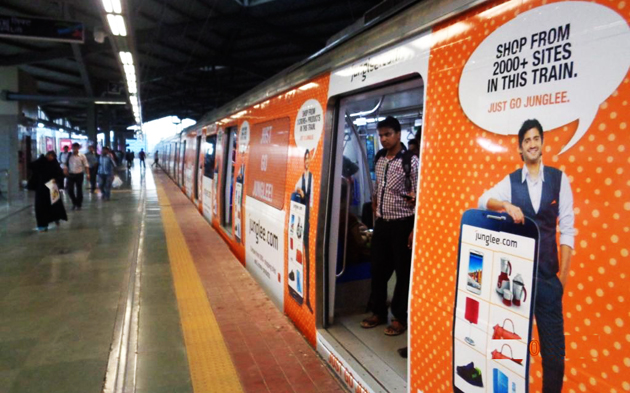
Metro and train advertising is a public transit branding method that involves advertising that is done in and outside metros or onto metro station assets. Metro station branding, metro full-wrap branding, and inside metro branding are great ways to target a more urbanized population. Commuters who regularly travel in metros and even trains for commutation purposes, tend to notice the vehicle’s outside branding wrapping. Be it while waiting at the platform or while looking around, metro and train branding is an effective way to catch your target audience’s attention and build a strong top-of-the-mind brand recall.
Metro branding is one of the forms of transit media advertising. If you wish to target even more commuters or corporate, working crowds, you can consider station branding as well.
3. Bus branding
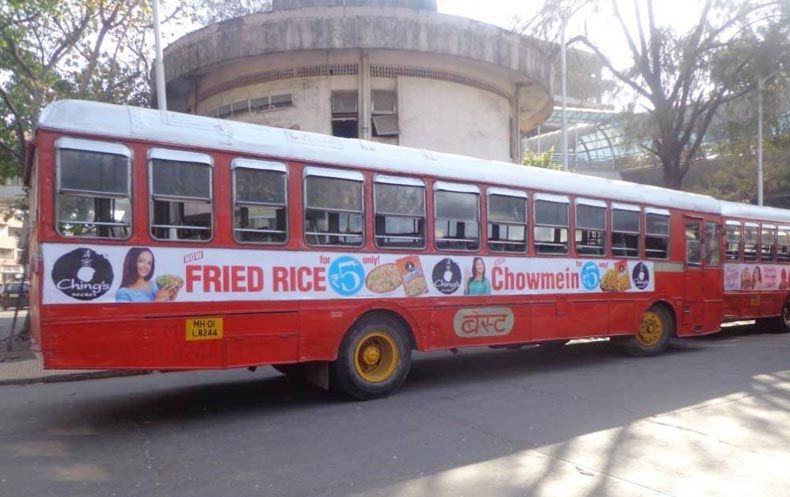
Bus branding is another kind of advertising wherein private and public buses aid in promoting the brand throughout the city or country. Bus branding is done through branded bus posters, bus wraps, backlit panel advertisements, advertising on bus sides, and bus seats. Also, a digital screen could be fitted inside the bus to engage even more consumers. An average urban bus travels around 150 to 300 kilometers per day covering 50K to 60K miles a year. The advertising mileage buses have proven to give is one of the main reasons why you will mostly see large-sized brands such as LIC, HDFC, Sony TV, or even top FMCG companies like Nestle, Hindustan Unilever doing regular bus branding campaigns to reach their target market.
4. Cab branding

Cab branding is a way of advertising your brand through cabs such as Uber or OLA or taxis. Cabs can act as mobile billboards, helping you target a more corporate audience. Cab branding is done by wrapping a poster or flex at the back, side panels, front or whole body of the cab. It increases brand visibility and helps in creating a better and stronger brand identity. Cab advertisements such as Uber or OLA ads are relatively less costly as compared to other transit media branding options such as metro branding or train advertising.
Advantages or benefits of Transit Media Branding
1. Transit media branding has a geographical plus point
Transit advertising is a wiser and smarter choice when it comes to local branding. Brands can make more out of their marketing budget by doing local branding to reach their target market.
They can select the market portion they desire to target and then place their ads on buses or trains in that specific region. Transit advertising is one of the highly classified mediums of advertising which is powerful for targeting the local consumer of a region. When a business decides to place transit advertisements in a select location, it is actively reaching out to people of a select demographic characteristic and background. For instance, a local restaurant advertises special offers on a bus stand that the customers often visit to reach that locality. This would help them be aware of the offers and products the place offers. This would in turn increase the customer footfall.
2. Transit media branding is cost-effective
Transit media advertising is like a large blanket spreading over a larger proportion of potential customers. It allows greater customer activation and acquisition at a lower cost. Therefore, transit media branding is one of the highly chosen methods of advertising for brands and businesses of all sizes. Unlike billboard advertising, you don’t need lakhs of rupees of budget to get started.
3. Provides you with long brand exposure time
While traveling in a bus or a plane, it is observed that people spend time noticing the brand around. For example, if you are on a seven hours flight and you see a brand wrap on the front seat, then you are likely to give it your attention both consciously and subconsciously. This is how it works. Even if it is a bus stand or a metro ride that displays your brand and that people use every day for traveling to work or other commutes, it aids in granting a longer exposure period. This would in turn make people refer to and choose your brand the next time they go shopping. Train advertising with full wraps is highly beneficial for brands. People following the same path would get your brand inside their minds without any effort, simply because it is displayed every day.
4. The coverage area is large in transit outdoor branding
Be it a bus or a cab, it is used by people for traveling almost all the time of the year. So when they enter or travel different streets or follow a particular route each day, so does your brand and that helps build a strong mind recall among your target audience. Transit media advertising facilitates effective brand activation through vehicles. For example, a bus with full wraps would display the brand in large size making it almost impossible to unsee for your target customers. Also, transit vehicles in India travel an average of 40 to 60 KM a day giving thousands of impressions. Transit media branding can help you spread your brand across a large geographical horizon repeatedly to build a good brand recall
Disadvantages or Cons of Transit media branding
1. Transit media branding depends on the public’s state of mind
We are humans and thus a collection of emotions. It is quite possible that at one point, an individual may not be in the mood to reflect upon and look around an advertisement. For example, a person sits on the bus and goes on to read a novel or take a nap. In this case, the purpose of transit media could remain quite defeated.
2. Routes may change overtime
A mode of public transport may not always take one way. According to the needs of the current times, the path of public transport is likely to change. During this time, it may not be able to cover a particular segment of the population.
3. Limitation on the creative front
Transit media cannot be highly customized and that is a disadvantage if we look the other way around. It is quite possible that at times the people who view the transit media advertising may not have a certain perception, need, or behavior of purchasing the particular product. For example, if a sports products ad is displayed to old-aged people, then they would never have the lifestyle of playing a sport actively at the age of 80. This is where there lies a boundary.
Conclusion
From the above key points, we can infer that while transit media advertising brings with it certain disadvantages, it is still quite effective in the long run. And today, various brands as discussed above are taking the help of transit media advertising to make their brand known to both local and non-local audiences. Transit media is not restricted to reaching one segment of the population but spreads the message throughout. Also, the cost involved is less compared to other advertising methods. Transit media acts as a moving brand billboard and it cannot be switched just like a television ad or even a digital online ad. It is seamless and offers brand visibility and brand activation in many ways!
Ginger Media Group is an established marketing agency that has done offline marketing for giant companies like OYO, Uber, Gillette, Unilet, & a lot more
Our agency focuses on a 360 degrees marketing approach that is customized to fit the requirements of our customers.
Checkout our transit media branding services
CONTACT
If you want to run an effective transit media campaign for your brand
Then contact us at,
+91 990 247 8800 or email at – contact@gingermediagroup.com
]]>In today’s fragmented media environment, brands are constantly on the lookout for new and innovative ways to engage with their target group.
Despite being occupants of a digital era, online advertising is beginning to frustrate media buyers as ad blockers are in widespread use. Even if a user does not use ad blockers, it is difficult to stand out as they are bombarded with several marketing messages on a daily basis.
Thus, to overcome these problems, brands are resorting to OOH (Out-of-Home) advertising to instil a sense of trust among their target group. The latest buzzword ‘OOH’ refers to advertising that takes place when someone is outside of their home. Billboards, signage and branded paper cups are fitting examples of OOH media. They cannot be blocked or skipped.
If you’re looking to reach a mass audience, Outdoor advertising is the answer. Today, the medium is continuing to outperform as most people spend time outside their home.
Importance of Measuring Marketing Campaigns
Though out-of-home advertising has gained immense recognition in recent times, there are still few media buyers that are reluctant to leverage on the benefits of the channel. The main reason being that tracking OOH campaigns is seemingly difficult compared to direct mails and newspaper adverts. Thankfully, in recent times, the industry that has struggled to calculate impressions has come up with innovative strategies and tools.
Therefore, it’s safe to say that choosing an outdoor medium is not just powerful but measurable as well.
Be it any campaign, actively tracking and measuring various metrics is important if you want to hit a particular goal. If you do not continually evaluate the effectiveness of a campaign, the time and money spent on marketing may be wasted.

Strategies to track OOH Campaigns
The following advertising metrics will help you track the success of OOH campaigns and measure return on investment (ROI)
Location: The most crucial factor when executing an OOH campaign is choosing the ideal location. Your aim is to target a particular demographic, with the right message and facilitate a strong CTA. Once you have determined your target market, the next step would be to use locations where a maximum number of people from your TG resides.
Code specific campaigns: Another highly effective method to track OOH campaigns is by printing discount vouchers, coupon codes and QR codes on your OOH media. Based on the number of people who visited your site and used the code during checkout, you can determine the effectiveness of the campaign.
Before and after sales: A simple way to calculate the performance of an OOH campaign is by looking at the sales conversion before and after running the ad. If there’s been a significant improvement, your campaign may be working.
Keyword analytics: If your campaign is associated with a memorable tagline or slogan, chances are your audience will go back and type keywords into a search engine. If those key searches turn up in your analytics, it’s again proof of the efficacy of your campaign. Similarly, hashtag metrics is also an effective method.
While tracking OOH campaigns, it is important to familiarise yourself with these terms:
- · DEC: Daily Effective Circulation –number of vehicles and pedestrians that pass a billboard per day.
- · OTC: Opportunity to Contact –how many people could walk past and see your outdoor advert.
- · VAC: Visually Adjusted Contact –number of people who saw the advert during the outdoor campaign
Today, cup branding has emerged as an effective medium in the OOH space. The main reason being that it can effectively be tracked post the campaign. Contrary to oversized billboards, paper cup ads are small yet powerful.
After every coffee cup advertising campaign, the team at GingerCup captures on-site photographs, conducts surveys and feedback, and records vendor responses.
 The responses to QR codes, coupon codes and microsites are also examined in detail.

The Baahubali 2 marketing team used cup branding in their marketing mix before the release of the film. The pre-bookings recorded were pulse-raising as nearly 1 million tickets were sold online within 24 hours.
To know more, email contact@www.gingercup.com.
]]>Ready to talk with a marketing expert?

A Pragmatic and innovative way to enthrall your target group is just a click away!
Get in Touch
Rukmini Knowledge Park, Kattigenahalli, SH 104, Srinivasa Nagar, Bengaluru, Karnataka 560064
+91-990 247 8800
contact@gingermediagroup.com
Popular in Television Advertising
Udaya TV AdvertisingSun TV AdvertisingStar Plus AdvertisingTV 9 AdvertisingZee TV AdvertisingNDTV India AdvertisingColors TV AdvertisingPopular in Airport Advertising
Spice Jet AdvertisingMumbai Airport AdvertisingDelhi Airport AdvertisingEmirites AdvertisingIndiGo Airlines Domestic India AdvertisingPopular in Newspaper Advertising
Deccan Herald AdvertisingPrajavani AdvertisingThe Hindu AdvertisingEconomic Times AdvertisingDainik Jagran AdvertisingHindustan Times AdvertisingPopular in Magazine Advertising
Forbes AdvertisingCosmopolitan AdvertisingBusiness World AdvertisingVogue Magazine AdvertisingPopular in Sports Advertising
IPL AdvertisingPopular in Outdoor Advertising
Billboard AdvertisingBus Shelter AdvertisingMetro Pillar AdvertisingUnipole Advertising© Ginger Media Group 2025. All Rights Reserved.